
Consulting

Make complicated work easier to run.

When work gets complicated, the problem is rarely one thing. Ownership gets fuzzy, information conflicts, implementations stall, and new tools create new handoffs. Bravura Works helps organizations find the structure underneath that complexity and turn it into work people can actually run.

Discuss a Project

When the work is harder to run than it should be.

Operational problems rarely arrive with a neat label. They look like work bouncing between teams, people working from different versions of the truth, implementations that never quite become operations, rework nobody can explain, or automation that made the process faster without making it clearer.

Capabilities

What Bravura Works can help with.

01

Operating models and workflow design

See how the work really moves, then make ownership, decisions, handoffs, and exceptions explicit.

When this helps

Work crosses teams, tools, or approvals and nobody can quite explain where ownership changes, why work stalls, or which exceptions matter.

What we do

We follow the work the way people actually do it, not the way the process map says they do. Then we clarify ownership, decision rights, handoffs, exceptions, and the evidence the process needs to stay reliable.

Possible outputs

Current- and target-state workflows, role and decision maps, exception and evidence maps, implementation priorities, and an operating playbook.

02

Implementation and operational readiness

Turn an approved idea into something the organization is actually ready to operate, from dependencies and readiness gates to training, cutover, and handoff.

When this helps

A strategy or design makes sense on paper, but turning it into day-to-day operations exposes dependencies, readiness gaps, training needs, or cutover risk.

What we do

We turn the approved design into an operating plan: sequence the work, expose dependencies, define readiness gates and acceptance tests, prepare people for the change, and make cutover, stabilization, recovery, and handoff explicit.

Possible outputs

Implementation and dependency plans, readiness matrices, rollout or cutover plans, training materials, acceptance plans, stabilization logs, and handoff packets.

03

Governance and source-of-truth design

Make it possible to answer a deceptively simple question: what governs right now?

When this helps

People can find plenty of information but cannot reliably tell which policy, decision, standard, or version governs now.

What we do

We identify which sources and decisions actually govern, make authority visible, and define how versions, changes, exceptions, and escalation are handled so teams can tell what to trust now.

Possible outputs

Authority maps, source-of-truth registries, decision-rights matrices, decision logs, governance charters, change-control protocols, and provenance models.

04

Knowledge and documentation systems

Turn scattered documents and institutional memory into knowledge people can find, trust, maintain, and pass on.

When this helps

Critical knowledge is spread across documents, inboxes, shared drives, systems, and people's memories, making retrieval, onboarding, and handoff fragile.

What we do

We turn scattered knowledge into an operating system people can use: clear structure, ownership, retrieval paths, templates, standards, versioning, and maintenance.

Possible outputs

Knowledge architecture, taxonomy and metadata models, documentation standards, SOP or playbook libraries, onboarding and handoff systems, navigation plans, and maintenance cadences.

05

Human–AI workflow design

Decide what AI should do, what people must still own, which sources the system can trust, and how to know when it is wrong.

When this helps

AI is already in the workflow, but the boundaries are fuzzy: what it may decide, which sources it may trust, when a person must intervene, and how its work gets checked.

What we do

We map the work across people, AI, and conventional automation, then make the boundaries explicit: who may decide, which sources govern, what permissions apply, what must be verified, when a person steps in, and how the system recovers.

Possible outputs

Human–AI task allocation, authority matrices, source-grounding contracts, workflow or agent specifications, tool and data permission models, verification protocols, recovery plans, operating guides, and test evidence.

06

Quality, validation, and recoverability

Build failure into the design conversation before failure arrives: what gets checked, what happens when something breaks, and how the operation gets back to a known-good state.

When this helps

The process works until an edge case, stale input, failed handoff, or irreversible action reveals that validation and recovery were bolted on afterward.

What we do

We define what must be true before work is accepted, connect requirements to tests and evidence, design checkpoints and exception paths, and make failure visible enough to diagnose and recover from.

Possible outputs

Acceptance matrices, test plans or harnesses, checkpoint and control maps, exception matrices, recovery runbooks, issue and defect registers, validation reports, and non-regression evidence.

Most real problems cross more than one capability. We combine the ones the engagement actually requires.

AI TRANSFORMATION & CHANGE LEADERSHIP

AI adoption isn't the same as changing how work gets done.

Bravura helps organizations redesign work around AI, clarify what people and AI should each own, prepare leaders and employees for the new operating model, connect governance to real workflows, and measure whether the change is actually producing value.

  1. 01

    Redesign the work. Start with the end-to-end workflow and business outcome, not the AI tool.

  2. 02

    Clarify roles and authority. Define what AI may assist, recommend, execute, or never decide, and what human judgment remains accountable.

  3. 03

    Build capability, not compliance. Prepare leaders, managers, and employees to operate, verify, challenge, escalate, and recover in real work.

  4. 04

    Measure adaptation, not just usage. Look for changed behavior, quality, risk, workload, and operating outcomes rather than logins or prompt counts alone.

  5. 05

    Prove value and sustain it. Establish baselines, pilot safely, scale through evidence, and leave governance, learning, measurement, and ownership with the client.

Start with the work that matters.

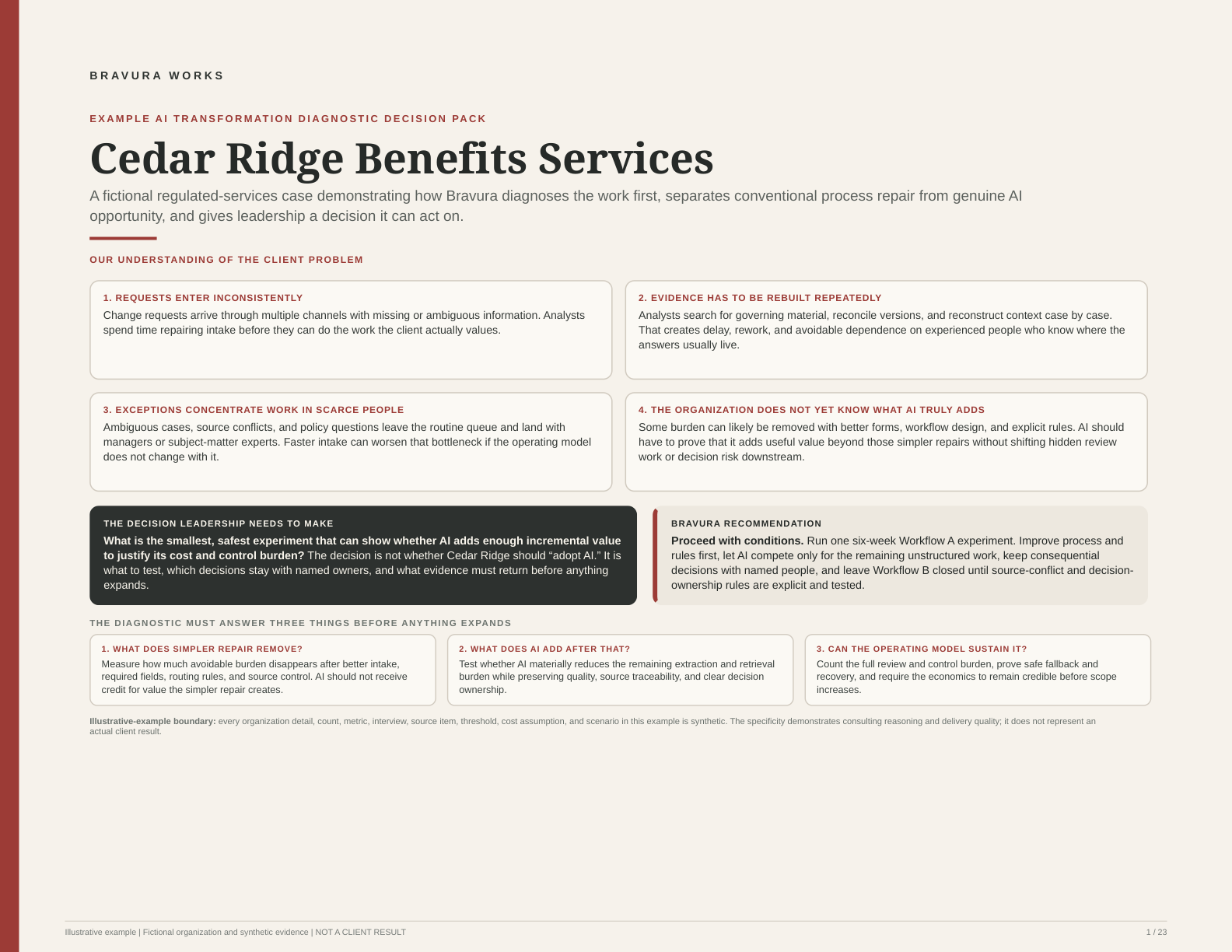
For organizations that need a clear starting point, Bravura offers a fixed-fee AI Transformation Diagnostic. We examine a bounded set of workflows, identify where AI can create meaningful value and where it should not be used, clarify human and AI roles and decision rights, surface governance and workforce implications, and recommend the first evidence-backed pilot.

The client receives an executive-ready decision pack and prioritized roadmap that stand on their own, whether or not Bravura is retained for implementation.

ILLUSTRATIVE SCENARIO

One problem. Several capabilities.

Here's what that can look like.

The situation

A growing operations team handles incoming requests across email, a shared spreadsheet, a CRM, and a library of policy documents. They have added AI to summarize requests, draft responses, and route work. It feels faster, but ownership is fuzzy, different people cite different policy versions, the AI sometimes uses the wrong source, and nobody can say exactly what must be checked before a response goes out.

What we discover

The AI is not the root problem. The team is running several overlapping workflows, ownership changes without being named, more than one policy source looks authoritative, and people are compensating with memory and judgment. The new AI has simply made those old seams faster and harder to see.

What changes

The repair is not better prompting. We separate the overlapping workflows, assign ownership and decision rights, establish which sources govern, define what AI can do and what still requires human judgment, and build verification, exceptions, and recovery into the operating model. Then we turn the target state into implementation, documentation, training, and handoff.

Possible engagement outputs

Depending on scope, the resulting package might include a target-state workflow, role and decision map, source-of-truth model, Human–AI authority and verification protocol, implementation plan, operating documentation, acceptance tests, recovery runbook, and handoff package.

Human-AI systems.

When the problem is specifically how people and AI should share work, authority, evidence, and recovery, Human–AI Systems Architecture goes deeper into that operating design.

Explore Human–AI Systems Architecture

Start with the actual problem.

We do not begin by fitting the problem to a methodology. We begin by understanding how the work actually behaves. Depending on what we find, the engagement might become a current-state assessment, workflow redesign, readiness package, governance model, documentation system, or bounded prototype. Scope and acceptance criteria are defined around the problem, not around a canned deliverable.

Who you’ll work with.

Consulting engagements are led by Dave Butler, whose career spans more than two decades in complex operations, implementation, governance, business analysis, and business leadership across regulated and global environments. He brings the perspective of someone who has had to make systems work from the executive table, the project team, the operating floor, and the owner’s seat.

Bravura Works provides business consulting. It does not provide legal, accounting, or other services that require professional licensure.

Begin a conversation

If the work is complex, start by making the problem clear.

Tell us where the work is getting harder than it should be. We can help determine what is actually happening, whether Bravura is the right fit, and what a useful first step would look like.

Consulting availability varies by jurisdiction and engagement type. We confirm fit and applicable requirements before accepting an engagement.